Beyond the Big Houses: A Guide to Grower Champagne
5 March 2026 · 8 min read
Your basket is empty
Discover our curated selection of artisan foods.
We joined the Marini family at dawn in the forests above Norcia to understand why the black truffle commands such reverence — and such prices.
There is a particular quality to the light in Umbria at five in the morning. It is not yet dawn, but the darkness has softened to a deep, bruised blue, and the air carries the mineral scent of damp earth and oak. It is in this half-light that Giancarlo Marini, third-generation tartufo hunter, sets out with his dog, a Lagotto Romagnolo named Biscotto, to search for what the Italians call il diamante della cucina — the diamond of the kitchen.
We had driven up from Norcia the previous evening, past the earthquake-damaged basilica and through the narrow streets of the medieval centre, to reach the Marini farmhouse perched on a hillside above the Nera valley. Giancarlo had greeted us with a glass of Sagrantino and a plate of bruschetta drizzled with last season's oil, and had spoken, with the measured pride of a man who has spent his life in the same hills, about the truffle.
The black Périgord truffle — Tuber melanosporum — has resisted every attempt at industrial cultivation. Unlike the white truffle of Alba, which cannot be farmed at all, the black truffle can be encouraged by planting oak and hazelnut trees inoculated with its spores. But the results are unpredictable, the yields modest, and the quality of a farmed truffle is, in the opinion of most serious cooks, markedly inferior to one found wild.
Giancarlo's family has worked the same 40 hectares of oak forest for three generations. The precise locations of the best spots are a closely guarded secret, passed from father to son with the solemnity of a legal document. "My grandfather showed my father," he told us, "and my father showed me. I will show my son when the time is right. Not before."
Biscotto is seven years old and has been trained since puppyhood to locate truffles by scent. The training, Giancarlo explained, begins with the dog being fed truffle-scented food as a puppy, so that the smell becomes associated with reward. By the time a Lagotto is two years old, it can detect a truffle buried 30 centimetres underground.
The hunt itself is a study in patience and collaboration. Biscotto ranges ahead, nose to the ground, while Giancarlo follows at a respectful distance, watching the dog's body language for the subtle signs — a slight hesitation, a change in the angle of the head — that indicate a find. When Biscotto begins to dig, Giancarlo moves quickly, gently moving the dog aside and using a small pick to extract the truffle without damaging it.
The truffle he held up for us that morning — roughly the size of a golf ball, dark and warty, smelling of earth and something deeper, more animal — would sell for approximately €400 per kilogram at the Norcia market. A particularly fine specimen could fetch twice that.
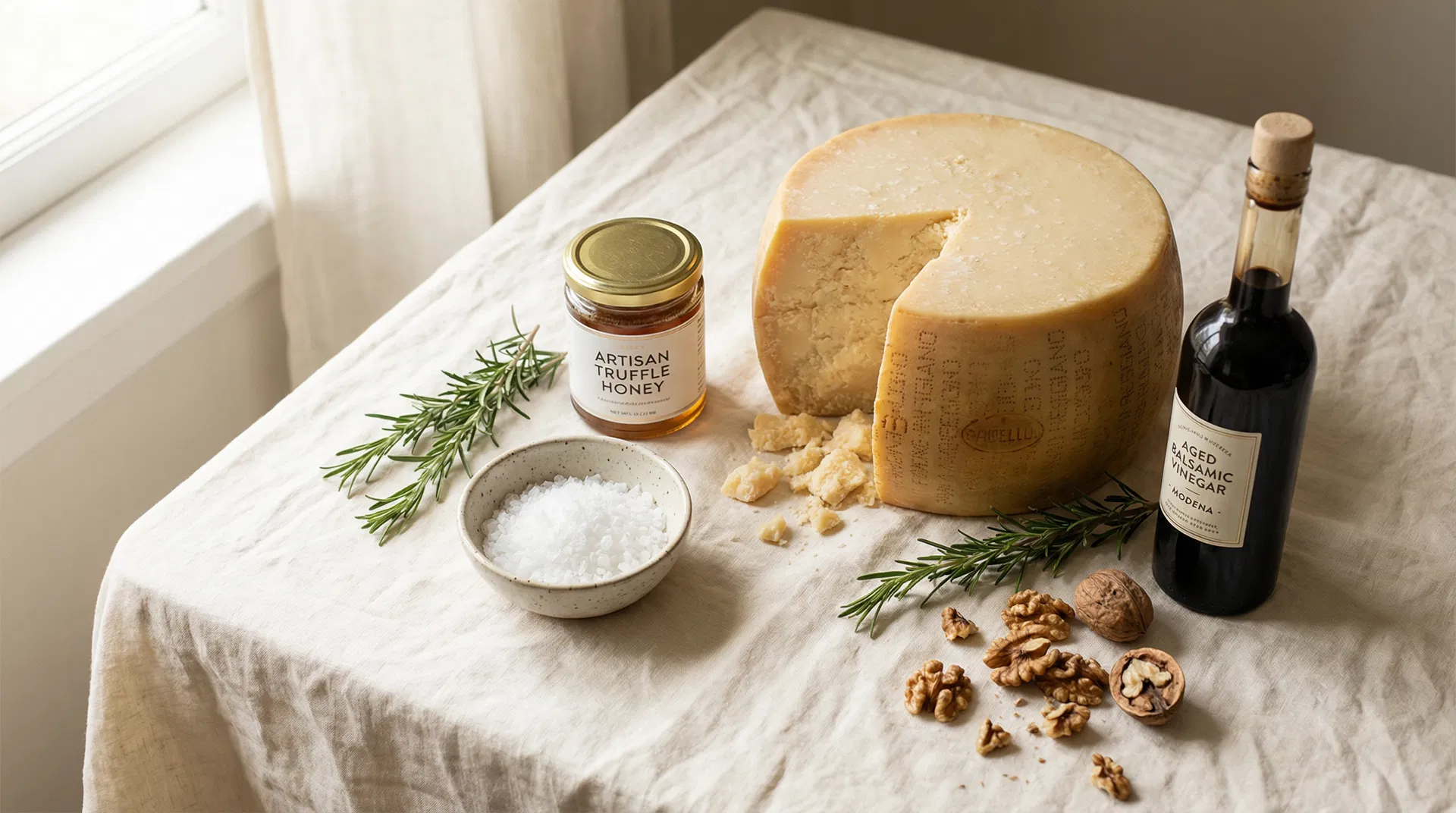
Our Black Truffle Honey is made by the Marini family using raw wildflower honey from their own hives, infused with shavings of hand-harvested truffle. It is, in our view, one of the most remarkable condiments in our collection — a product that captures, in a single jar, the character of a landscape and the knowledge of a family.
We value your privacy
We use cookies to enhance your browsing experience, process payments securely, and — with your consent — to analyse site traffic. Strictly necessary cookies are always active. Cookie Policy · Privacy Policy